

Photographing Field Hockey: What a Nikon Workshop Taught Me About Fast Action Sports
Updated: Jul 24

Getting Into Sports Photography: Breaking the Devil’s Circle
Getting a foot in the door of sports photography is something I’ve had to rethink over the past few months. It’s a bit of a devil’s circle: to get accreditation, you need an affiliation with a media outlet, but to get that affiliation, you already need connections within the sport. Sure, you can start small with local clubs and hope to work your way up, but from the outside the industry feels like a closed insider’s club.
That’s when I stumbled upon Nikon School’s workshop at a professional field hockey match: the FIH Pro League in Berlin. It offered exactly what I couldn’t get anywhere else: a spot on the sidelines, a Nikon pro guiding me through the dos and don’ts, and a chance to learn the real workflow of shooting fast‑action sports.
I signed up, and on the day showed up at the predefined meeting point with my workshop teammates, whom I had never met before: I was cool and collected on the outside - if you disregard my profuse sweating due to being late and having to jog a few miles from my parking spot with 20 kg of gear in 35 °C heat - but was really excited about being a pro sport shooter for a whole day.
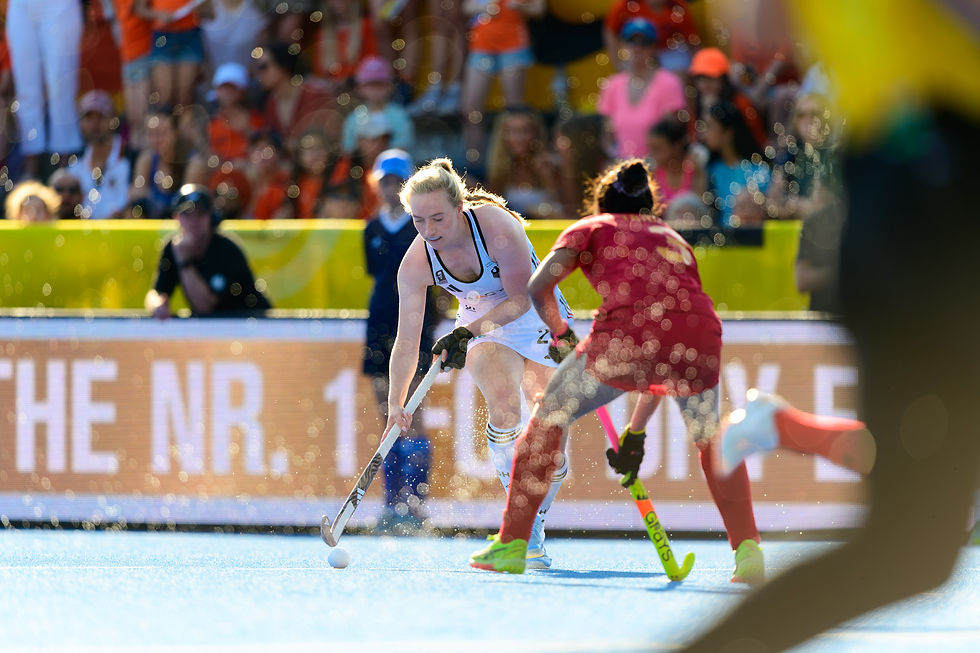
Pre-match ceremony: Flag bearers enter before the day's opening match National anthems: Team China stands lined up ahead of kickoff On the move: Sara Strauss (#21) drives low under pressure. Sideline pressure: Lisa Nolte carries past Yang Liu (#3).
Why I Joined the Nikon Field Hockey Sports Photography Workshop
My expectation for the workshop was to learn the intricacies of framing, sideline work - as in picking the best spots for every on‑field action - and getting an insider look at the work of a pro sports photographer. Another hope was to make connections with the “inside”.
The Nikon School announcement didn’t have any information regarding the level of the workshop; it turned out to be geared towards amateurs having a fun afternoon rather than a commercial photographer trying to get real‑world pro sports experience.
Expectation vs. Reality: A Workshop Geared Toward Beginners
The course content started with the basics: setting your camera to continuous autofocus instead of single AF and making sure to have release mode continuous at the highest frame rate your camera is capable of. Participants were also reminded to keep the shutter speed above 1/1000 s.
But most of our time in the classroom session was spent on telling us all the things we were not allowed to do and all the places we were not allowed to be. They had to instill the sports-photographer etiquette and behavior guidelines into a bunch of amateurs who had zero knowledge about these things:
No moving around during plays
Getting onto the field in any shape or form gets you ejected right away
no getting in front of broadcast cameras and especially not in front of the big display showing the game replays and the video umpire
Changing sides was only permitted during quarter breaks and only using a predefined path behind the stands
The pros were allowed a few more places, like at the sidelines and all the corners.
Drive to the circle: Attacking space under a lunging block. China's Yang Liu (#3) scoops an aerial pass over a challenge. Water spray in high speed: Nike Lorenz (#2) launches a low drive. F-mount prime power: Shot on Nikon Z7 + AF-S 500mm f/4G ED VR. Freezing peak action: Z9 tracking an intense 1-on-1 stick tackle. Shadows on the blue turf: Low-angle sweep pass by Emma Davidsmeyer (#23).
Thrown Into the Action: Field Hockey Is Fast
Despite the limitations of my movement, I did not have time to envy them; field hockey turned out to be a fast-paced, fast-action spectacle that I, as a newbie, had problems following sometimes.
I knew very little about hockey when I first signed up for the workshop, but was aware that knowing the game you try to photograph is essential for success. I checked the rules online, watched a bit of gameplay, but I did not have access to full game broadcasts, which left me lacking the experience needed to anticipate what was coming instead of reacting to plays already happening. One time I completely missed out on a corner – a game element that works a bit like a penalty with high chances of scoring – because I couldn't follow the gameplay and concentrate on taking pictures at the same time. I had to let go of the bad habit of chimping - trying to see whether I got the previous play - which was a result of my over-excitement and the effect of insecurity; you will never see me chimping in a wildlife or macro shoot setting. I always know what I got after pressing down the shutter, without feeling the need to look at the LCD screen of my camera.
My Gear Choices: Z9, Z7, and Two Very Different Lenses
The camera I am talking about were actually two: I had my trusty Nikon Z9 with me and originally wanted to take a second body as a backup since I only have one Z9. The options were my Zf, my first gen Z6, or my wife’s first gen Z7. I seriously thought about testing the Zf in a pro sport setting, and it is the only backup body with Nikon’s latest image processor – the Expeed 7 – giving the Zf some serious power under the hood. I chose the Z7 mainly for the matching 45 MP resolution - cropping is essential in field hockey - and, I’ll admit, partly because I didn’t want to show up with the retro‑styled Zf on a pro sideline. Which might seem like a strange choice, especially with all the online vitriol regarding the autofocus capabilities of the early Nikon Z mirrorless bodies. But more on that later.
The 100–400 mm vs. the 500 mm: What Worked and Why
I wasn’t a 100% sure about the lens choice either; since hockey is played on a field roughly the same size as soccer, I knew that I have to look at lenses in the 100 to 500mm range to be able to cover players getting close to me without cutting their heads off, but also cover plays at the other end of the field. It didn’t help that the photography spots we were allowed to shoot from were unknown when preparing for the workshop. I ended up taking my Nikon Z 100-400mm f/4.5-5.6 VR S and my trusty old AF-S 500mm f/4G VR; I figured the f/4 lens would come in handy once the floodlights came on for the men’s game later in the day. The 100-400 ended up being the best choice to cover any action starting at the center line and moving closer towards the goal line. Being able to zoom with the moving player enabled me to frame up any kind of shot I could think of, from a close-up of a single player to a duel of an attacker and the line of defenders.
The 500mm was great at getting close to the action at the other end of the field, and the f/4 aperture really helped with separating the subject.
At first, I foolishly thought that I would have time to switch lenses when the ball was turned over and the other team started storming the goal nearest me; how silly I was! Players were on top of me before I could even try to put the other lens on my Z9, so the Z7 intended for backup ended up becoming firmly attached to the 500mm, with me switching between the Z9 with the 100-400 and the Z7 with the 500mm. I bet you are curious how the seven-year-old, “slow” and “crappy” autofocus of a 45MP Z7 performed with the 13-year-old 500mm attached via an FTZ adapter: it was spectacular! Neither the body nor the lens missed a beat and could follow all the action. I used to photograph swallows picking off mayflies from the water surface of a flowing river with that combo successfully; no matter how fast field hockey seems, it is slower than that. “But what about the frame rates?”, you may ask. Is 8fps in 14bit RAW enough to get the moment when the stick hits the ball with water spraying in golden light? Yes, it is.
Mid-air scoop: Stine Kurz (#14) launches an aerial (Z7 + 500mm f/4). Low sweep tackle: Chen Yang (#23) contesting the ball, shot on Z7 + 500mm f/4. Driving the flank: Sara Strauss (#21) holds off Zou Meirong (#26) on the Z7 + 500mm f/4.
All the above images were shot with the Z7 and the 500mm lens
What the Pros Shoot With
The biggest hurdle with the 500mm was not the ability of the body or the lens to grab focus for the decisive moment; it was more the distance and other players getting in the way and blocking the view. This is the only reason I ended up with only 21 flagged images from the Z7 + 500mm combo vs. the 100-plus images of the Z9 + 100-400mm combo. The pros were shooting the Z 70-200mm f/2.8 VR S II on a Z9 and the Z 400mm f/2.8 TC VR S on another body, doing the same dance of switching between them depending on subject distance. Having a fast f/2.8 zoom and a similarly fast prime at 400mm on two bodies seemed to be the pro photographer’s choice of weapon.
The Human Element I Completely Missed
Our workshop leader encouraged us to ask as many questions as we liked, but during the game there were very few lulls to have any kind of conversation going. We ended up doing our thing with the occasional comment on success or failure of capturing a rare gameplay moment or a goal.
After the first game I tried to collect my thoughts and get back into the second game with all the experience I could gather. I tried to focus more on the important elements of the game and less on the technical aspects of a stick hitting the ball. But also I was reminded by my dear wife sitting in the stands not to forget the human element. I have lots of action shots with one-on-one duels and brilliant overheads – a kind of lobbed pass - but completely forgot to capture any of the human interactions: the coming together in cheer after a goal, the high fives, the frustrated communication, both verbal and body language. I completely failed to capture the reactions of both players and spectators, and my images failed to tell the story of the game. My biggest takeaway would have to be to get better not at the technical aspects of sports photography but at the storytelling. I had to figure this out for myself since there was no time or place to review any images during the break between matches, and our workshop leader didn’t even try. Other participants went to the VIP tent to get food and drinks. I ended up transferring my images to my laptop for the teacher to not look at them at all, and go about his normal business of mingling with the higher-ups of the league. In hindsight, it would have been better for a serious teaching-style workshop to be extended to two days, with a single match on each day and a review and teaching session in between.
Finding the human element. Despite my initial frustration, a closer look at the frames revealed I actually did manage to catch a few genuine player interactions after all.
The Shootout I Wasn’t Allowed to Photograph
The women’s game ended in a win, while the men’s game ended in a draw after the 4th quarter, which prompted a shootout, since FIH Hockey Pro League matches cannot end in a draw. If the score is tied at the end of the 4 quarters, the teams immediately go to a penalty shootout. Whatever the process is of deciding which goal to use for a shootout, we ended up at the wrong corner of the field; it all happened at the opposing goal, and since we were not allowed to cross the field – like the pros were at this point - or walk over to the other corner, our workshop simply wasn’t allowed to take images of the shootout. I was left with a bad taste in my mouth and a bit of frustration: was the workshop worth it?
Due to the late ending of the men’s game everybody wanted to rush home, there was no discussion or analysis. We were encouraged to share our images with the DHB (German Hockey Association); supposedly they needed them for social media and their magazine, which felt a bit off putting. I paid a pretty penny for the workshop, the travel, and the lodging to not be able to photograph the highlights and culmination of one of the two games I got access to, and then the organizers hoped to get my images for free, while also restricting me from using any of them commercially. The limited, aimed-at-complete-beginners tutoring also made me feel like I got short-changed.
But was it really a bust? I guess I had too high hopes for a workshop primarily aimed at hobby photographers.
Here are my takeaways
Insight Into the Pro Level: I got a real insight into sport photography at the pro level with access to a professional league. I learned about field-side behavior and the processes of sport photography.
The Real-Time Workflow: I also learned that a sport shooter isn’t a one-man band; they are connected through the internet to an editor, who gets images transferred in real-time and send them to media clients to be published while the game is still on.
In-Camera Discipline: The pros do not shoot RAW and edit it later like I do in wildlife and macro photography - they must get it right on the spot, in camera. Upon reviewing my images, I had to realize how much editing in post was required to polish them, with many underexposed due to challenging lighting conditions.
Metering Adjustments: Although I switched from my usual Matrix metering to Center-weighted, I learned that I would have been better off switching to Spot for the times players were backlit or in the shadows with a bright background.
Storytelling Over Technique: I also had to learn that telling the story of a game is more important than getting lots of action shots. Emotions make the game! When only a few images are used for an article on the league website or social media posts, it is the moments of joy, winning, success, failure and struggle that get the spotlight.
Final Verdict
Was it worth it? Absolutely! The experience spurred me on to try and get a position with a media outlet and I am looking for possibilities to shoot more sports at any level I can get access to.
If you want to support my work, you can find all the gear I use in my Amazon shopfront. As an Amazon Associate, I earn from qualifying purchases — at no extra cost to you.

Hi, interesting read. I am a wildlife photographer too, and since my son has taken up hockey, i am taking more sports photography too. I appreciate your commentary. I have been asked by the French Hockey association to provide photos for them, so i am now divining into this steep learning curve. :). Found you page while researching "good examples of field hokey photos", so kudos for your searchability :)
Hi, I discovered your website through a post relayed by Nikonrumors. This current post is interesting.
First, I didn't know Nikon organized such workshops, I'll check with Nikon Pro France if they also do. I shot motorsporst for 15 years, first on film with manual focus, then AF then in Digital, so I'm used to quick moving subjects and covering events. What you say about trying to follow the game and shoot is extremely difficult and you should have no regret for a first time. Besides motorsports, I attended 4-5 football games, two golf tournaments, a couple of horse and camel races and two athletism meetings. Remembering of them, I realize that not knowing the rules or the players and without experience in these sports,…