

How the Sony a7V Signals the Death of the Hybrid Revolution
Updated: Jul 24
The Prologue
It is nighttime. A Japanese Exec rides in a shaded limousine’s back seat, the lights of Tokyo pass by. Based on his looks, he could be mistaken for high-ranking military if not for his expensive suit. The car is driving stealthily -not racing, but at speed- to get to its destination quickly. It rolls up to an industrial-looking building. He gets out of the car and, with steady, swift steps, rushes in. He enters a big, shiny, elegant lobby that oozes wealth and status. Golden colors, well lit, like a 1930s luxury hotel, but modern, with crystal light fixtures and glass interior. He walks through the lobby and disappears into a hidden, dark corner of it. That corner is not visible for a guest or a casual person walking in the lobby; it is hidden by visual trickery and shadows. Only those who know where to go, and where the hidden door is, can find it.
Through the door, the atmosphere changes. The luxury golden lobby turns into a dark wood-clad, samurai palace-style corridor. The lights are low, and there is no one there. He walks ahead with intent and with the self-assured movements of someone fully in control of the situation and a clear goal. He gets to a small octagon-shaped room. There are no seats, no tables, nothing welcoming a guest. The walls are the same dark wood but with golden Japanese inlays.

A warden steps out of a dark nook that is hidden by shadows, impossible to tell where he came from; he just walks into the light and greets the mysterious man with a deep, respectful bow that the Exec does not reciprocate. Despite the deep bow, you can feel that the warden is in control and is there to make sure only the chosen ones are allowed to go any further. He examines the man, identifies him by taking a long, hard look at his face, then bows again and steps aside, showing the man to the door behind him that just becomes visible as a light slowly comes on above the hallway leading towards it.
The Exec slowly moves towards the door and is now clearly hesitant, or less self-assured, as the weight of the situation causes him to tremble a bit. He knows that the place he is going to walk into is no child’s play; stepping in has consequences. Inside the vault is a crystal, box-like container that holds a mythical object. It looks a bit like Mjölnir, Thor’s hammer, but with ancient Japanese classical Kanji script. You can see that it is ancient not only from the script on it, but the form itself shows it was handmade by blacksmiths from another time. It is rather big, but when the Exec opens the container and takes it out, it appears light; he can wield it easily.

Once he has the hammer, another hidden door opens, not the one he came in through, that leads him through another hallway right to a waiting car in a subterranean garage. The car rushes off after the Exec hastily jumps in. It almost jumps as it surfaces through the garage exit ramp and drives off. While on his way, he is staring at the hammer in his lap with admiration and fear, as if it were a weapon of mass destruction. He can feel the power of it, but that power also makes him scared.
He arrives at the destination, which is an R&D facility, jumps out, and rushes up to a room filled with Japanese engineers and camera prototypes, and parts and machinery for testing. The engineers are busy working on a new prototype camera. The Exec sees this crowd of engineers and the camera in their midst from the far end of the room. His expression gets hard, ruthless, as he walks right up to the prototype. The engineers step back, a bit in shock as they realize who is approaching. They know this man, although no one knows his name.
He lifts the hammer above the prototype, and as he does, a young engineer tries to step in and intervene, but an older engineer holds him back, like a mother protecting their child. The young engineer looks at him confused and bewildered but then understands and stands down, steps back to his place. The Exec with the hammer sees this movement from the corner of his eye and freezes, leaving the hammer lingering at the peak of its downward arc. Once he sees that the young engineer has learned his place, he looks around to check that all the others are also compliant. He can see the sadness in their eyes. They know what is coming. The prototype they have poured all their skills into will be hammered down to a less capable, less innovative product by greedy corporate heads who have no love for the art of engineering or photography. They have seen this before during the DSLR era, but they hoped that after the fierce competition of the early mirrorless cameras, the dreaded hammer would never see the light of day again. They take their fate with dignity, hardened faces with no tears. They do not bow their heads in submission, though; they stand straight and look the Exec right in the eye.
The hammer strikes down! A steely ping can be heard, and a flash of light blinds everybody. When the light levels are back to normal, the prototype sits in the same spot among the engineers without visible damage. But they know that is not the case. The damage has been done. It is a Sony a7V.
The man with the hammer disappeared during the light show, and he is back at the vault placing the hammer in the crystal container. In the background, two men appear, same haircut, similar suits, but one wearing a Nikon tie, the other a Canon one. The Exec turns around, sees them; they greet each other with a nod. He walks away, and the men from Canon and Nikon step closer to the crystal container holding the hammer with an evil smirk, ready to make good use of it.
The Reality Behind the Fiction – What the Sony a7V Reveals
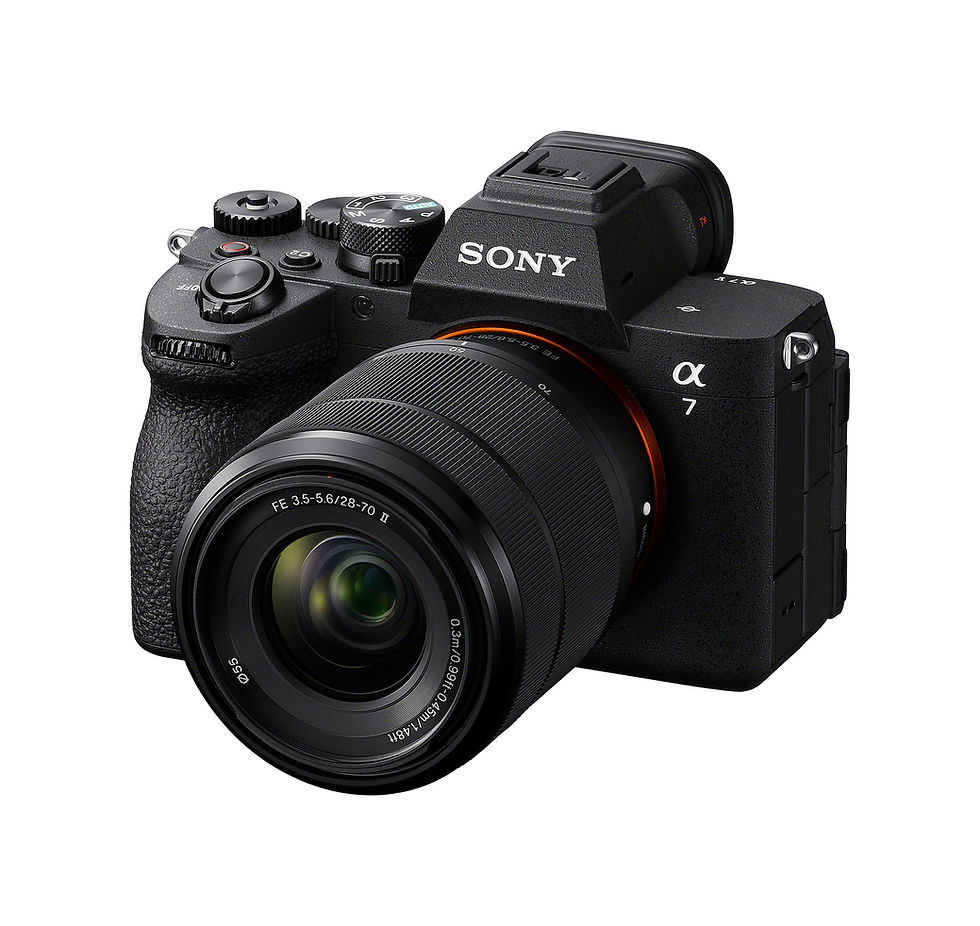
The internet drama around the announcement of the Sony A7V might feel like just a few people being upset about their favorite manufacturer not giving them all the goodies they asked for. But this could not be further from the truth. That release is the final signal of a changing landscape in the industry. Although there will always be people with unrealistic demands, this latest uproar was the culmination of Sony faithfuls seeing a trend with the latest offerings that this younger generation of photographers haven’t experienced before. Long-time photographers were used to this from the CaNikon duopoly back in the DSLR days. Many made the switch to Sony specifically during the mirrorless revolution to get away from the market segmentation tactics of the big two, and they never expected Sony, the disruptor, to play by the same rule book.
Sony tried to compete in the DSLR market with A-mount cameras that, while being good offerings with some novel tech inside, simply couldn’t compete against CaNikon. This was mostly due to the established user base being firmly locked into each manufacturer’s system. When Sony changed tactics and decided to go mirrorless, they went all in; fast model iterations, an ear for user needs, and jam-packing every release with all they could fit into a camera body. This quickly established them as a competitor and gave them a devoted fan base of photographers and videographers. Creating the hybrid camera we take for granted today was their biggest move, as it became the most sought-after product of the last decade due to shifts in entertainment and all connected technologies.
I say that Sony created the first real hybrid camera even though Canon was first to make DSLR video a reality with the 5D Mark II, but also made sure it would not compete with their cinema line, hence I don't count it as a real, modern hybrid. (Yes, Nikon’s D90 was first, beating Canon just by a few weeks, but with a crippled 5-minute 720p video, mono audio and no manual exposure settings. They had the first-mover advantage and completely wasted it because they didn't treat video seriously.)
During Sony’s early push to get as big a user base as they could, they didn’t hold back and threw the absolute kitchen sink at their mirrorless cameras. Non-line skipped 4K video, oversampling and full-frame readout, S-Log picture profiles, focus peaking, zebra patterns, 120fps slow motion, and custom button mapping. They didn't care if a feature cannibalized their higher-end video cameras; they just wanted market share.
This lit a fire under the big two. First, they had to admit defeat regarding the superiority of mirrorless over DSLRs. They rushed their mirrorless entries to market with lots of rough edges, still trying to protect their DSLR moneymakers, as if keeping a backdoor open in case the mirrorless revolution stalled. Missteps that would cost them more market share during those years. Sony pushed on with its strategy and forced the big two to play catch-up. This caused real competition to win customers, and a time of relentless innovation.
Nikon was hit the worst with a loss of almost half of their interchangeable lens camera market. Nikon had to take a page out of Sony’s playbook to stabilize its losses when they brought the Z9 and the Z8 to market; both cameras priced lower than the competition and packed with every bit of tech Nikon had. The Z9 was the first mirrorless hybrid to have internal RAW recording not crippled by overheating (I am looking at you, Canon R5), but the fact that both Canon and Nikon had to pull out all the (photographic) stops shows how much they were pushed by Sony.

Fast-forward to today when the duopoly turned into a triopoly; Canikony. We seem to be back to the era of the same hardware making it into two-three camera bodies with minor tweaks to the hardware, but major firmware-based differentiators, dressed up in vintage, cinema/video, or SLR style bodies, forcing consumers to buy multiple variations of what is fundamentally the same camera.
Why the "Cripple Hammer" Is the Ultimate Modern Business Model
From 2017 until 2023, CIPA shipment numbers completely cratered. The industry didn't just stagnate; it hit a historic low in 2023, dropping to just 7.87 million total digital cameras shipped worldwide. However, the market has recently experienced a slight, unexpected upward bounce. Total shipments climbed to 8.37 million units, and further surged to 9.44 million units. But before the camera executives start celebrating a "new golden era," we have to look at where that growth came from.

The Casual User Is Buying Compacts, Not ILCs
If we look under the hood of the recent CIPA data, the slight growth in the industry isn’t because millions of new people are buying into full-frame mirrorless ecosystems. The massive driver of growth has been fixed-lens compact cameras (driven by the viral internet fame of things like the Fujifilm X100VI and high-end point-and-shoots). Compact camera shipments skyrocketed by nearly 30% in units and a staggering 49% in financial value. Mirrorless ILC shipments grew by a modest 12%, while DSLRs plummeted by another 31% (shrinking to just 690,000 units globally). Most importantly, CIPA's internal data shows that production and shipments of 35mm full-frame sensors and larger decreased slightly, while crop-sensor bodies (APS-C and Micro Four Thirds) took up the slack.
This exposes the core issue: the modern Interchangeable Lens Camera (ILC) user base is completely locked in, and the industry knows it. Because the pool of full-frame ILC buyers is stagnant and fiercely locked down, camera companies have realized a grim corporate reality:
They cannot rely on a steady stream of new customers to grow their revenue.
When you cannot grow your user base, you only have one option to satisfy shareholders: You must extract more profit from the users you already have. This is exactly why the "Cripple Hammer" exists today. Sony knows that an a7IV shooter who has several thousand dollars invested in E-mount glass is incredibly unlikely to sell everything and switch to Nikon or Canon, and vice versa. Since that user is locked into the Sony ecosystem, Sony doesn't need to give them a "kitchen-sink" upgrade in the a7V to stop them from leaving.
Instead, they hit the a7V with the hammer, limiting its video modes just enough so that if that loyal user wants to expand their production business, they are forced to spend significantly more money to move up into Sony's FX cinema line. The triopoly doesn't fight for new customers anymore; they just build higher walls inside their own kingdoms. The latest viral camera doing this is Nikon’s Zr. While many online reviews rave about the R3D RAW codec, it is nothing more than a firmware update to the internals of a Z6 III, packaged with a bigger, better 4-inch screen, 32-bit float audio, and the removal of the mechanical shutter and the EVF, dressed in a video‑style body.
On top of this, new releases from each manufacturer don’t aim to outperform the competing similarly priced models of the others, they only match their capabilities or surpass them slightly, just enough to get ahead until the next iteration hits the market. This is bad for consumers, but it will also stifle the industry's ability to innovate long term, causing even fewer consumers to buy their latest cameras. This is the downward spiral we have witnessed during the last years of the DSLRs, when upgrading wasn’t cost-effective for most working photographers. We are seeing it again with the a7V, where many YouTube reviewers admitted at the end of their videos that they won't be upgrading from their a7IV, another historic first for Sony.
And to be clear: this isn’t a dig at Sony. All three major manufacturers are playing the same game.
I’d love to hear your perspective, feel free to share your thoughts in the comments.
If you want to support my work, you can find all the gear I use in my Amazon shopfront. As an Amazon Associate, I earn from qualifying purchases — at no extra cost to you.


Comments